Airwrap Range Reset
Collapsing 500+ SKUs into a three-tier global portfolio — and repositioning Airwrap for growth amid Dyson's first revenue decline in 22 years.

PROJECT DETAILS
Scope
Global · Two parallel programmes
Timeline
2025
Location
Philippines
Program/s
Airwrap Origin + i.d
01 CONTEXT AND ROLE
A product portfolio grown without architecture — and a business that needed it fixed
As Associate Design Manager, I was appointed programme owner for the Airwrap Range Reset — two parallel projects tasked with restructuring the entire Airwrap offering into a coherent, tiered global portfolio. My accountability ran from brief through regional alignment, product and colorway decisions, and global launch.

02 PROBLEM DEFINITION — THE WHY
Three compounding failures that made the status quo untenable
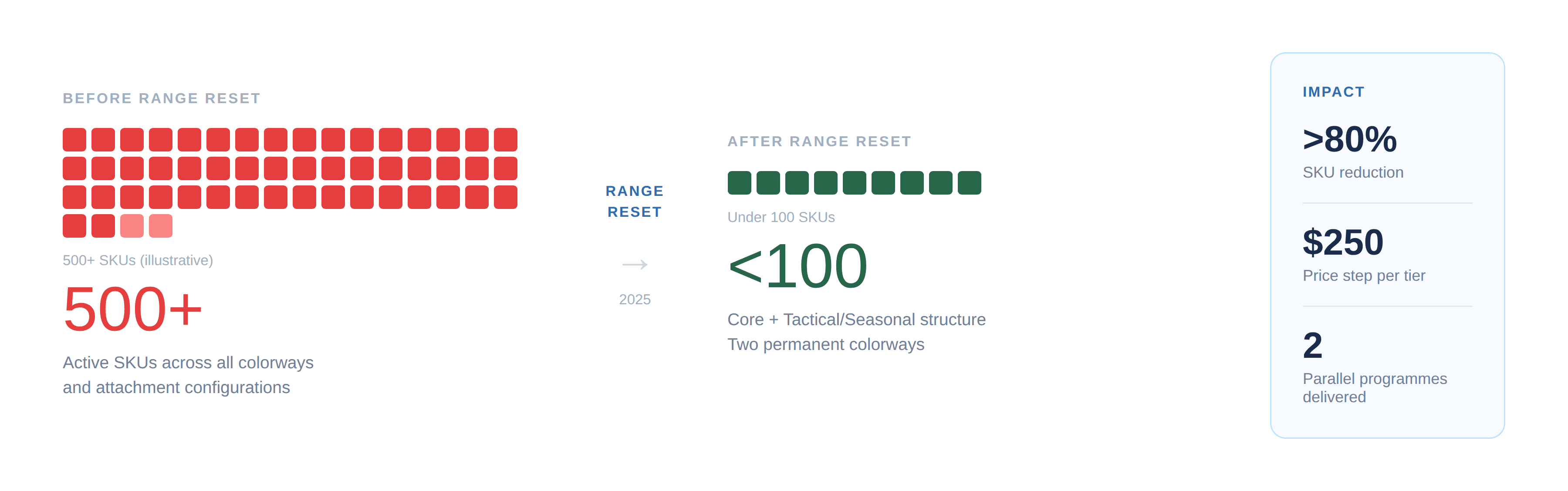
Operational drag. 500+ SKUs accumulated with no pruning — distributors like Sephora bore inventory costs with no commercial justification. Post-holiday search demand dropped 75–78% in early 2025.
Consumer confusion. Near-identical products at overlapping price points caused purchase paralysis. Rising 'Airwrap dupe' searches signalled premium positioning was eroding.
No architecture for Co-anda 2x. A $749 flagship launching without a legible entry and mid-tier would read as expensive, not aspirational.
There was also some geographic gap. No portfolio strategy existed for South Korea — one of the fastest-growing premium beauty markets globally.
03 DISCOVERY AND RESEARCH
Building a fact base defensible to regional teams with competing interests
Before any portfolio decisions were made, I led a structured discovery process spanning four workstreams.
SKU Audit. Mapped every active SKU by colorway, attachment config, regional availability, and sell-through velocity — establishing which variants were commercially justified vs. legacy carries.
Regional Sell-Through Analysis. Worked with EU and APAC commercial teams to surface which regional variants reflected genuine demand vs. portfolio proliferation without purpose.
Consumer Journey Mapping. Purchase path data consistently showed abandonment — not conversion — when customers faced too many near-identical options.
South Korea Market Scoping. CAGR projections, K-wave social data, and premium spend patterns built the case for South Korea as a named strategic priority.
FINDING The problem wasn't regional preference complexity — it was the absence of a structural framework to contain it. More customization wasn't the answer; tiered architecture was. |

04 SOLUTION AND STRATEGIC APPROACH
A three-tier portfolio architecture with a Korea-first APAC pivot
The reset introduced two structural categories — Core (two permanent colorways) and Tactical/Seasonal (limited-edition event drops) — and a three-product ladder at $250 price intervals.
The $250 price step signals genuine capability differences while keeping each tier attainable as an upgrade. Origin anchors the brand entry; i.d. captures the mid-market; Co-anda 2x sustains Dyson's aspirational positioning.
South Korea — Strategic Market Focus
South Korea's beauty tools market is projected to reach USD 8.93bn by 2035 (14% CAGR), with K-wave amplifying Airwrap's 4.7B+ TikTok/Instagram views into direct purchase intent. The reset embedded South Korea as a named priority — influencing colorways, attachments, and channel decisions.

05 EXECUTION & ITERATION
Two parallel programmes, competing regional priorities, one launch window
The Range Reset ran as two concurrent NPD programmes — Origin and the i.d. re-launch — under shared governance with a launch window tied to Co-anda 2x.
SKU rationalisation framework. Built evaluation criteria across regional sell-through, attachment popularity, inventory exposure, and manufacturing complexity — designed to be defensible to regional teams, not imposed on them.
Regional stakeholder alignment. Navigated EU and APAC commercial teams with conflicting market priorities. The South Korea pivot required building a data-backed case from scratch to earn buy-in.
Attachment curation for i.d. Defined the seven-attachment lineup and premium case spec — balancing perceived value, BOM constraints, and shelf differentiation between Origin and Co-anda 2x.
Scope iteration under pressure. As Co-anda 2x's launch window firmed up, both programmes had to flex scope and sequencing. Regional teams wanted more variants — the brief required fewer.
06 RESULTS & IMPACT
A portfolio rebuilt for clarity, margin, and long-term growth
The reset created the strategic preconditions for Co-anda 2x's premium positioning and directly addressed Dyson's commercial pressures. The South Korea pivot embedded a new growth engine in the global portfolio architecture.
PAIRED IMPACT The Range Reset and Beauty Value Engineering programme (separate case study) addressed both sides of Dyson's profitability equation simultaneously — revenue quality through portfolio clarity, and cost efficiency through manufacturing rigour. |
WHAT I'D DO DIFFERENTLY Earlier quantification of consumer confusion costs — abandonment, returns, support volume — would have accelerated regional buy-in at the programme's start. | WHAT I'D REPLICATE Running Origin and i.d. as parallel programmes with shared governance saved months. The SKU rationalisation framework is directly replicable across any multi-SKU hardware portfolio. |


