Beauty Value Engineering
Delivering $60M+ in combined savings across Airwrap and Supersonic — simultaneously managing two programmes, three workstreams, and five manufacturing plants.

PROJECT DETAILS
Scope
Global · Lifecycle & NPD
Timeline
2025 (Oct expansion)
Location
Philippines
Program/s
Airwrap + Supersonic
01 CONTEXT & ROLE
A company-wide margin mandate — and what I was asked to deliver
In 2024, Dyson's pre-tax profits fell 47% to $713M — the steepest decline in the company's history. A company-wide mandate to improve manufacturing margins across the Beauty portfolio was initiated for 2025.
I was appointed programme owner for Airwrap value engineering from the outset. In October 2025, Supersonic was also transferred to me mid-execution — adding a second product line, new cross-functional team, and overlapping delivery timeline.
02 PROBLEM DEFINITION — THE WHY
Finding efficiency through precision — without compromising what makes Dyson, Dyson
'Cost reduction' is the outcome, not the work. The brief was to identify where efficiency could be found without touching what makes these products premium. Every component exists for a reason — the question was which reasons no longer justified the cost.
Scale. 10+ individual initiatives ran across three workstreams and two product lines, each with different teams, suppliers, and approval bodies.
Regulatory exposure. PCBA and motor re-architecture on both products triggered mandatory re-certification — adding non-negotiable lead time to the highest-value workstream.
Multi-plant logistics. Airwrap's 5 Asian factories each held legacy inventory. Coordinating simultaneous depletion and cut-in without production stoppages was the hardest operational problem.
Mid-year transfer. Absorbing Supersonic in October — mid-execution on Airwrap — tested programme governance in a way sequential ownership never would.
03 DISCOVERY & RESEARCH
A component-level teardown as the foundation for every decision
The programme began with a systematic teardown of both products — every component evaluated against three questions: source more efficiently? Redesign without functional impact? Optimise the process?
Component teardown. Each sub-assembly mapped against BOM cost, manufacturing process, and quality risk. High-cost, low-differentiation components became the primary target list.
Supplier market analysis. Second-sourcing exercises qualified alternates meeting Dyson's quality standards — reducing unit costs and single-supplier concentration risk simultaneously.
Experience validation framework. For any user-facing change — tactile finishes, attachment redesign, packaging — a validation protocol confirmed perceived quality was maintained or improved.
Regulatory pre-assessment. Pre-assessed PCBA re-certification scope and timeline before committing to the workstream — making compliance the known critical path, not a late surprise.
04 SOLUTION & STRATEGIC APPROACH
Three parallel workstreams — Airwrap and Supersonic side by side
Both programmes shared the same three-workstream structure, with Airwrap carrying the fuller scope and Supersonic running on a compressed timeline from October.
STRATEGIC FRAME Value engineering at this scale requires holding two things in tension: a forensic eye for inefficiency, and an uncompromising instinct for what defines the product's value. Paired with the Range Reset, these savings translated directly into margin expansion. |

05 EXECUTION & ITERATION
Two programme rhythms, one unified framework — and the hardest logistics problem
Execution required maintaining distinct supplier relationships, compliance timelines, and cross-functional teams for each product — while preventing either programme from drifting out of alignment with the broader mandate.
Workstream 1 — Materials. Recycled resins, textured finishes, second-sourced components, and cord standardisation delivered quick wins across both products with minimal regulatory exposure.
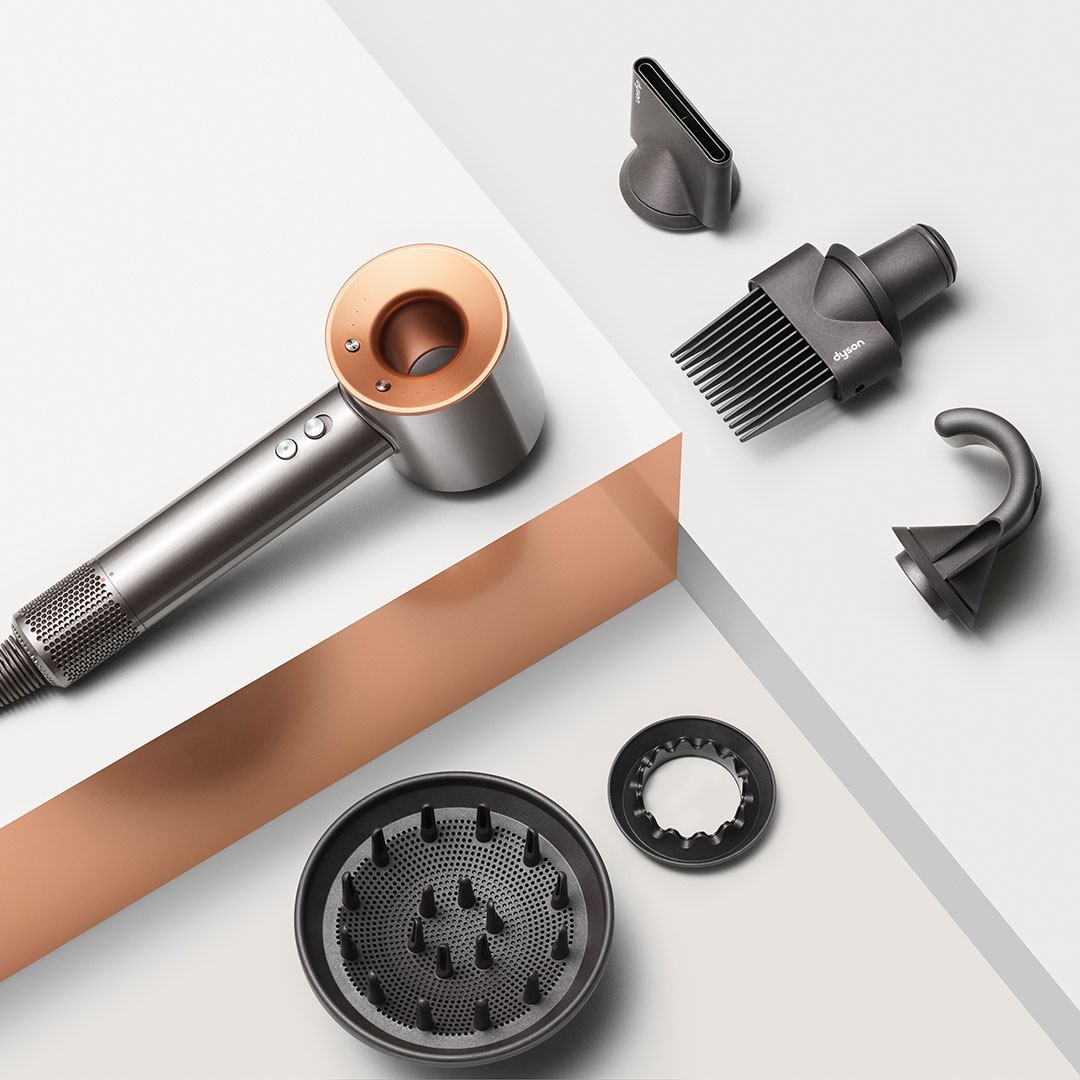
Workstream 2 — Design (Airwrap only). The unified patented smoothing brush — replacing two hair-type variants — required concurrent design, engineering, and IP work. Conical barrel upgrades ensured performance parity.
Workstream 3 — PCBA re-architecture. The most complex and highest-value workstream. Iterative fit/assembly testing and reliability qualification were required before production cutover on both products.
Phase-In / Phase-Out — 5 Manufacturing Plants
Airwrap's 5 Asian plants each held different legacy inventory levels. A sequenced depletion framework staggered cut-in dates by plant — ensuring all facilities reached new-material production within the same target window.
PROGRAMME MANAGEMENT NOTE As programme owner across both products, stakeholder alignment spanned industrial design, electronics, procurement, manufacturing, regulatory, quality, and commercial teams — all with competing priorities. A single source of truth and consistent decision cadence were as important as any technical deliverable. |

06 RESULTS & IMPACT
$60M+ in verified savings — structured to compound into 2026 and beyond
$50M+ from Airwrap and $10M+ from Supersonic in H2 2025 alone — a direct contribution to Dyson's margin recovery at a moment the business needed it most. Re-engineered components and rationalised supplier relationships carry forward into 2026.
Absorbing Supersonic in October without slipping Airwrap's schedule demonstrates the ability to scale programme ownership laterally under pressure — bringing new teams up to speed without losing delivery quality on the original scope.
IN CONTEXT Paired with the Airwrap Range Reset, these programmes addressed both sides of Dyson's profitability equation: revenue quality through portfolio clarity, and cost efficiency through engineering rigour. |
WHAT I'D DO DIFFERENTLY Earlier integration of regulatory re-certification planning into the PCBA timeline would have compressed the critical path — compliance should run parallel with design validation, not after it. | WHAT I'D REPLICATE Running all workstreams in parallel was the right call — a sequential approach would have deferred savings by 12–18 months. The phase-in/phase-out depletion framework is replicable across any multi-plant hardware programme. |