Co-anda 2x: UX Lead
Designing every user-facing interaction on Dyson's most advanced hair styler — from the feel of a button click to the intelligence of a sensor-driven machine.

PROJECT DETAILS
Scope
Global NPD · Full product
Timeline
2023 – 2024
Location
Philippines
Program/s
Airwrap Co-anda 2x
01 CONTEXT & ROLE
A complete product re-architecture — and the UX mandate at its centre
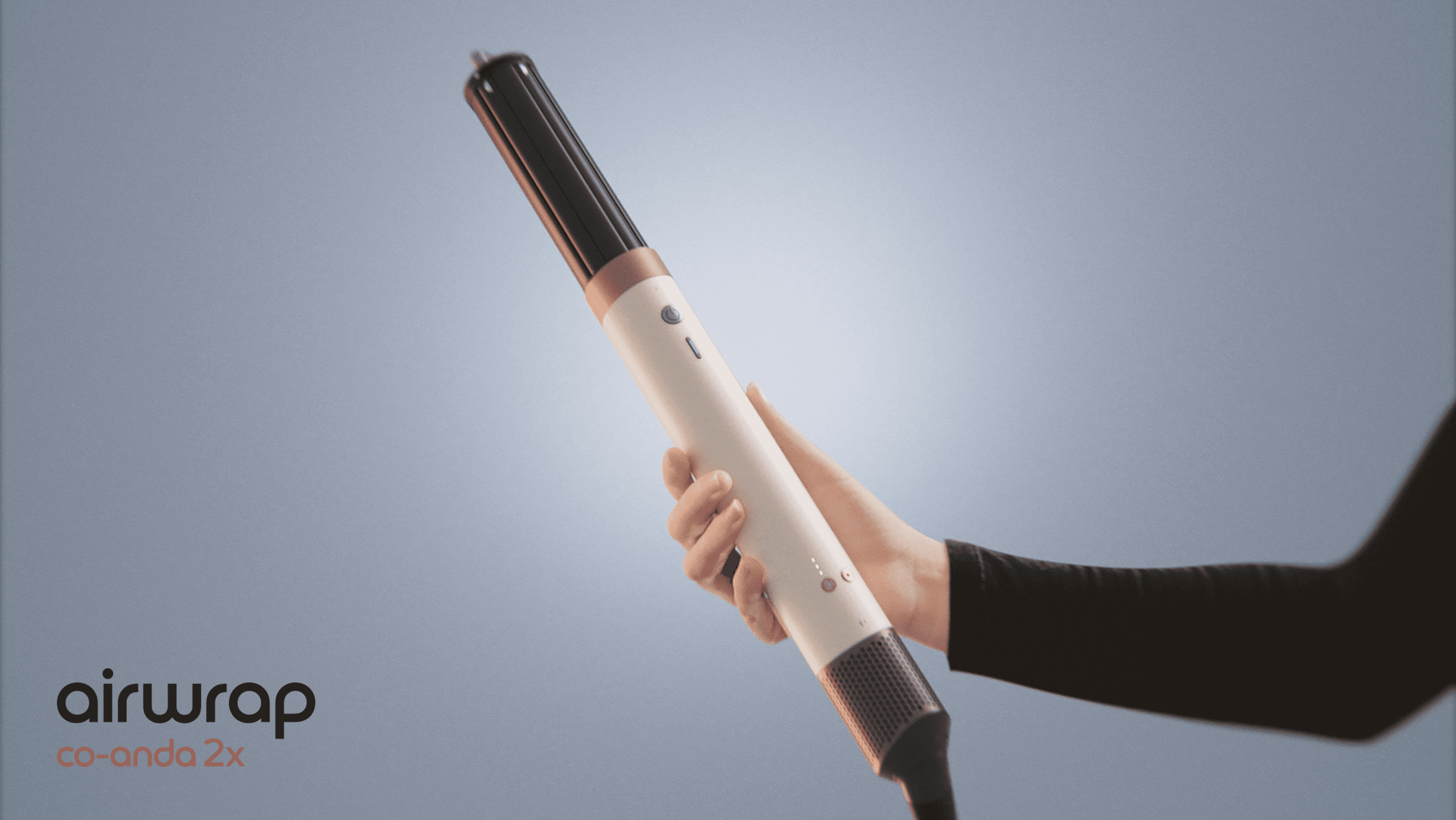
Airwrap Co-anda 2x was built to be faster, stronger, and lighter — with intelligence that made every session feel effortless. Achieving that required a new Hyperdymium 2 motor, a redesigned handle, an expanded sensor suite, and a new generation of smart attachments.
As UX Lead in the Design Engineering team, I owned everything the user touches, sees, and interacts with — and managed two teams: one on the physical UI layer (shaft, buttons, light guides), and one building the full directory of user flows, machine behaviours, and edge cases.
02 PROBLEM DEFINITION — THE WHY
More intelligence creates more design complexity — not less
THE CORE TENSION Every layer of intelligence added had to feel invisible. The machine needed to know when it was picked up, which attachment was fitted, what the user intended — and respond correctly, every time. Smarter product, simpler experience. |
Physical constraints. Reducing shaft diameter while fitting more sensors, a new motor, and redesigned buttons — all without compromising the feel of a premium product.
No UX precedent. RFID attachment recognition, accelerometer-based curl detection, and pressure interactions had never been designed into an Airwrap before.
Cross-system dependencies. LED logic, button states, firmware behaviours, and app states were all interdependent — a change in one rippled across hardware, software, and app design.
Edge cases at scale. The interaction space across new sensors, attachments, and app-machine states created hundreds of scenarios — every one had to resolve gracefully.
03 DISCOVERY & RESEARCH
Building the interaction model from first principles
Before any UX decisions were made, the team invested in foundational discovery work that governed every subsequent design choice.
Sensor capability mapping. Worked with electronics hardware to understand the full capability envelope of each sensor — what RFID range, accelerometer sensitivity, and pressure thresholds the hardware could reliably deliver.
Use case library development. Built a comprehensive library covering every meaningful user-product interaction from first power-on through advanced app customisation — the master document used across hardware, firmware, and software teams.
Physical UI benchmarking. Benchmarked button feel, click ratio, and light illumination against premium consumer electronics across beauty, audio, and personal care to establish the quality bar.
Edge case discovery sessions. Ran structured sessions with firmware and app teams to identify undefined or ambiguous machine behaviours before hardware was locked — significantly cheaper than validation-phase discovery.
App experience research. Reviewed onboarding and personalisation patterns across connected premium hardware to understand what makes app integration feel like a product extension, not a setup burden.
04 SOLUTION & STRATEGIC APPROACH
Two tightly coupled layers — physical UI and intelligence — unified into one experience
The UX strategy was built on a single principle: every visible interaction should be the minimum necessary to deliver the maximum intelligence. The machine does the thinking. The user feels the result.
Physical UI decisions and intelligence layer decisions were designed concurrently and continuously reconciled — a button placement change had firmware implications; a behaviour state change had LED and app implications. Keeping both in sync was a continuous design management discipline.
05 EXECUTION & ITERATION
Five parallel workstreams across hardware, firmware, software, and app
The UX Lead role here was fundamentally a translation and integration role — the connective tissue between every sub-system that touched the user. Each workstream below ran in parallel with regular integration reviews.
Hardware integration. Defined interaction requirements for every sensor in engineering language — RFID sensitivity thresholds, put-down response times, LED state specs — defensible to the electronics team.
Physical UI iteration. Multiple prototype rounds on button flushness, recess depth, and click ratio within the reduced shaft profile. LED illumination logic developed and validated under real styling conditions.
Firmware — curl sequence. Defined the user-facing parameters of the i.d. curl algorithm: what the machine does in each phase, what the LED communicates, and how it varies by hair type set in the app.
App — MyDyson connectivity. Led the full connectivity experience: Bluetooth pairing, six-question hair profile, real-time settings sync, and OTA updates. Multiple flow simplification rounds to reach what reviewers called 'absurdly easy'.
Edge case dual-track. Dedicated team for edge case resolution ran separately from the primary flow team — fast progress on main journeys without blockers, hundreds of scenarios resolved before validation.

06 RESULTS & IMPACT
Launched globally July 2025 — demand and critical reception validate the approach
What reviewers said — mapped to my work
The features most consistently praised in post-launch coverage map directly to the systems I led.
CNN Underscored on attachment recognition:
"Its smartest multi-styler yet. RFID enabled attachments auto-adjust to the best heat and airflow."
CNN Underscored on i.d. curl (accelerometer algorithm):
"The i.d. curl sequence gave me blowouts that last three days — my straight hair never held curl before"
Her World Singapore on physical UI:
"The slimmer handle made a noticeable difference — much easier to grip even with tendonitis."
Marie Claire US:
"With the Coanda 2x, I'm somehow able to dry and style my hair faster and easier. It blows every other hair tool I own out of the water."
Marie Claire UK on physical UI:
"The first thing I noticed was the weight — or rather, the lack of it. True to Dyson form, they considered every last detail."
The Quality Edit on app onboarding:
"Setting up the app was absurdly easy. Took like five minutes."
THE TRANSITION Managing teams across physical UI and interaction library workstreams — while maintaining sub-system alignment — was the direct preparation for programme ownership as Associate Design Manager. The discipline of owning an outcome across team boundaries scales regardless of programme size. |
WHAT I'D DO DIFFERENTLY A more structured requirements framework before hardware was locked — mapping each sensor to its use cases earlier — would have reduced late-stage edge case discovery and back-and-forth with firmware teams. | WHAT I'D REPLICATE The dual-track model (primary flows team + edge case team running in parallel) was the right structural call. Fast progress on main journeys without edge cases becoming blockers. Directly replicable on any product with complex state management. |


