The Blade Concentrator
Dyson's precision answer to a competitive threat: designing a five-part attachment that brought perpendicular airflow to the entire Airwrap ecosystem, without touching its architecture.

PROJECT DETAILS
Scope
Single attachment, Global launch
Timeline
2023-2024
Location
Philippines
Program/s
Airwrap
01 CONTEXT AND ROLE
My first product ownership — and Dyson's first direct competitive response in beauty
The Blade Concentrator was my first project at Dyson and my first time fully owning a mechanical assembly as a Senior Design Engineer. I worked alongside two other design engineers, with accountability for full development from concept through to launch.
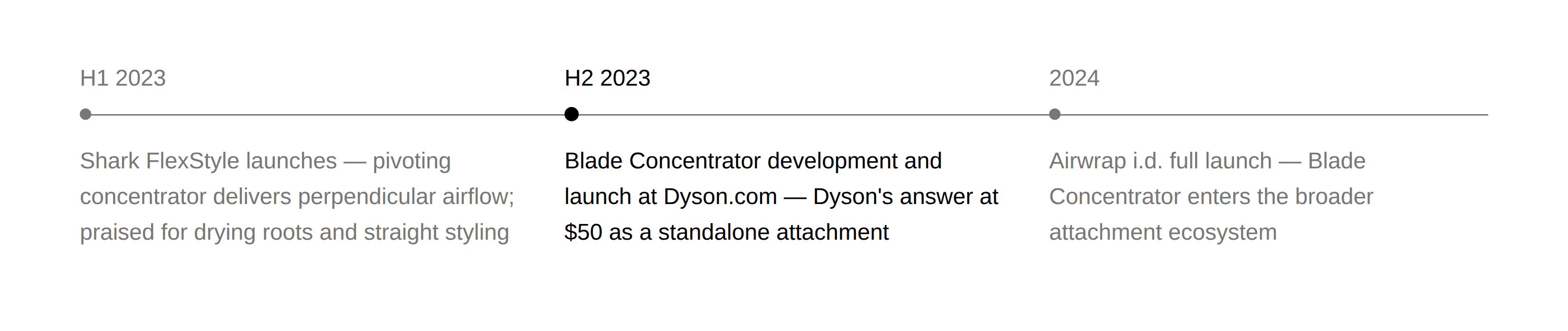
The product arrived in a sharp competitive moment. In H1 2023, Shark released the FlexStyle — a multi-styler with a pivoting handle that delivered perpendicular, concentrator-style airflow that Airwrap had never offered. Reviewers consistently praised this feature for making root drying and straight styling significantly easier.
02 PROBLEM DEFINITION — THE WHY
A competitive gap — and the right way to close it without compromising the platform
The Shark FlexStyle's concentrator feature exposed a genuine capability gap in Airwrap's repertoire. The question was not whether to respond — it was how.
THE STRATEGIC CHOICE Completely re-engineering the Airwrap wand to pivot would have been expensive, technically complex, and inconsistent with Dyson's engineering ethos. Instead: offer the same perpendicular airflow precision as a $50 standalone attachment. Existing users get the capability. Dyson protects its architecture. |
Shark FlexStyle | Dyson's response | Blade Concentrator |
Pivoting wand converts to hairdryer shape delivering perpendicular airflow — praised for drying efficiency and root access | Don't re-engineer Airwrap architecture. Offer perpendicular airflow as a $50 standalone attachment for existing users | Dual Coanda jets converging at a precision airfoil tip. 360 degree swivel. Compatible with all Airwrap generations. No architecture change required |
The Blade Concentrator also addressed a use case gap within Airwrap's own range. The existing Fast Dryer and Coanda Smoothing Dryer both deliver airflow — but neither produces the precise, blade-thin stream needed for section-by-section straight styling. The concentrator gave that use case a dedicated, purpose-built tool.
03 DISCOVERY AND RESEARCH
Understanding the use case, the competitive gap, and the engineering constraints
Discovery ran across three parallel tracks: competitive benchmarking, use case mapping, and engineering feasibility within Airwrap's existing connector architecture.
Competitive benchmarking. Analysed the Shark FlexStyle's concentrator in detail — airflow direction, ergonomics, styling outcomes, and user feedback. Identified what users valued most: perpendicular, directional air delivered while holding the wand like a traditional hairdryer.
Use case mapping. Mapped the existing Airwrap attachment repertoire against straight-styling workflows. Confirmed the gap: no attachment delivered a precision blade of air for section-by-section drying, best used in combination with a round brush at the roots.
Airfoil design research. Explored Coanda airflow delivery mechanisms — specifically how two jets converging at a shared tip could produce a sharp, coherent stream. This became the core aerodynamic concept of the attachment.
Manufacturability brief. The PRD included an explicit challenge from James Dyson: limit the assembly to five plastic parts. Discovery mapped which functions could be consolidated into shared components without compromising toolability or robustness.
04 SOLUTION AND STRATEGIC APPROACH
A beak-shaped airfoil with dual Coanda jets — precision airflow in five parts
The Blade Concentrator draws two jets of Coanda airflow across the surfaces of a beak-shaped head, converging at the airfoil tip to produce a sharp, focused stream — precision styling without turbulence or diffusion.
The 360 degree swivel gives users access to difficult angles — particularly the back of the head — without requiring awkward arm positions. Compatible with all Airwrap generations, priced at $50 as a standalone accessory.
Engineering across three dimensions
The brief required excellence across industrial design, aerodynamics, and mechanical assembly simultaneously.
INDUSTRIAL Form and Manufacturability
| AERODYNAMICS Airfoil and CFD
| MECHANICAL Assembly and Robustness
|
05 EXECUTION AND ITERATION
Design reviews, CFD simulation, and meeting a five-part constraint without compromise
Execution ran across three parallel workstreams — form, airflow, and assembly — with continuous integration reviews to ensure decisions in one domain did not create problems in another.
Industrial design iteration. Multiple design review cycles to achieve seamless curve transitions across the beak-shaped head. Textured finishes replaced painted surfaces throughout. Every split line from tooling was a deliberate design decision, not a default.
CFD simulation and acoustic work. Internal air channel geometry underwent intensive CFD simulation to optimize flow and minimize turbulence. Physical mock-ups validated simulation results. Turbulence is both an airflow inefficiency and a noise problem — both were addressed.
Five-part constraint. James Dyson's brief to limit the assembly to five plastic parts forced intentional consolidation throughout development. The constraint ultimately improved the design — fewer parts meant fewer failure points, simpler tooling, and lower unit cost.
360 degree swivel development. The swivel mechanism required fit and retention testing under real styling conditions. It had to survive repeated use without introducing play or looseness — a durability standard consistent with the Dyson brand.
Launch timing. While the broader Airwrap i.d. launch was delayed to 2024 due to development setbacks on other attachments, the Blade Concentrator was ready on time. It went on sale at Dyson.com in late 2023.
AN HONEST NOTE There is a fair argument that this attachment was over-engineered relative to its commercial footprint. The PRD was detailed and we met every requirement. In retrospect, that thoroughness directly enabled on-time delivery — and the discipline of that process laid the foundations for everything that came after. |
06 RESULTS AND IMPACT
Sold out in the first month — and a personal foundation for what followed
The Blade Concentrator sold out its first stock allocation at Dyson.com within a month of launch — early demand validation for a product filling a genuine gap. It is now carried at Sephora, positioned as a focused airflow tool for straight and smooth styling across all hair textures.
Long-term traction remained limited. TechRadar noted the concentrator is not included in any Airwrap bundles, observing that Dyson does not appear wholly committed to it as a mainstream addition. The product found its audience among users who specifically needed precision directional airflow, but did not achieve broad attachment status.
PERSONAL IMPACT This project was the most formative of my career at Dyson. Owning a full mechanical assembly from brief through launch — managing CFD work, design reviews, toolability, and manufacturing readiness simultaneously — directly prepared me for the UX ownership I took on for Co-anda 2x, and the programme management work that followed. The discipline of delivering within tight constraints on your first project is something you carry forward. |
WHAT I'D DO DIFFERENTLY The level of PRD detail and review rigour was appropriate for a first project at Dyson, but may have extended timelines beyond what the commercial footprint warranted. A leaner specification on lower-visibility requirements could have freed capacity for earlier market validation. | WHAT I'D REPLICATE Meeting James Dyson's five-part constraint was the single most valuable design discipline of the project. Forced part reduction produces better design — fewer components, more intentional geometry, cleaner tooling. It is a principle I have applied to every product decision since. |


